
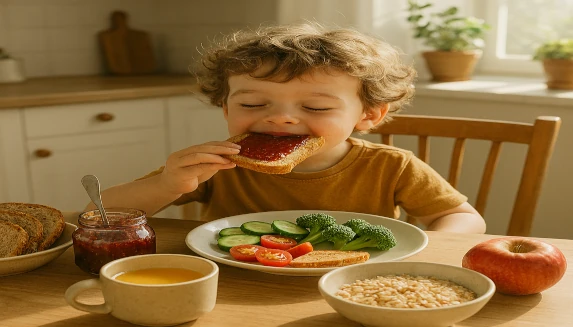
Building healthy eating habits for kids can sometimes be more challenging than parents expect.
Many well-intentioned feeding practices—such as children stretching out playtime instead of eating, parents who only offer food when a child asks for it, long stretches between meals in the hope that hunger will eventually win, snacks built around a single piece of fruit, and meals that end almost as soon as they begin.—can unintentionally make healthy eating more difficult. The good news is that simple adjustments to meal and snack routines can help children develop a better relationship with food, support healthy growth, and make mealtimes more enjoyable for the whole family.
Letting Play Win: Kids Stall and Skip Meals
Toddlers and preschoolers are wired to prioritize movement over sitting still, and that instinct gets stronger right around the time children become mobile. Pediatricians note that when babies start walking or running, they often prefer moving around to sitting down for a meal, and many toddlers eat less during developmental leaps because exploring the world simply feels more urgent than food. Busy schedules compound this: when kids are absorbed in play or activities, they may genuinely not notice their own hunger cues until they’re already overtired and cranky.
The instinct to let a child finish playing “just a little longer” before meals is understandable, but it removes the predictability that helps kids tune into hunger in the first place. In addition, many challenging behaviors are triggered by hunger. (Learn practical responses in our guide to effective discipline strategies for ages 2–6.)
The more useful approach is to make mealtimes a fixed, expected part of the day rather than something that competes with play. A short warning a few minutes before a meal (“we’re eating in five minutes, let’s start wrapping up”) gives a child time to mentally transition. Keeping meal and snack times consistent, even on days when a child skips one, helps them learn there’s a reliable next opportunity to eat rather than an open-ended invitation to keep playing instead.
Feeding Only When Asked
Some parents wait for a child to request food before offering it, treating hunger cues as something the child should initiate. This sounds respectful of a child’s autonomy, but pediatric feeding specialists draw an important distinction here. The widely used Division of Responsibility framework , developed by dietitian and family therapist Ellyn Satter and endorsed in pediatric nutrition circles, splits feeding into two separate jobs: parents decide what is offered and when and where it’s offered, while children decide how much (and whether) to eat from what’s in front of them. Feeding only on a child’s request collapses that division — it hands the “when” job to a child who doesn’t yet have the experience to manage it well, often resulting in irregular intake, grazing, or a child who simply forgets to eat until they’re overtired and irritable.
The fix isn’t to force food on a child who isn’t hungry. It’s to keep the timing decision with the adult. Offer meals and snacks on a predictable schedule regardless of whether the child has asked, and let the child decide how much of what’s offered to actually eat. Over time, this consistency is what allows children to build trust in their own hunger and fullness signals, rather than depending on remembering to ask.
Leaving 5–6 Hours Between Meals
The idea that a longer gap between meals will build up appetite and lead to better eating makes intuitive sense, but it tends to backfire with young children. Toddlers have small stomachs and immature blood sugar regulation, and most pediatric guidance points to far shorter intervals than five or six hours. Many one- and two-year-olds do best eating roughly every 2 to 3 hours, which typically works out to three meals plus two to three snacks across the day. The American Academy of Pediatrics specifically recommends two to three planned, seated snacks daily for toddlers to fill nutritional gaps between meals, rather than long unstructured stretches with nothing offered.
When the gap between feedings runs too long, blood sugar can dip low enough that a child becomes irritable, fatigued, or so ravenous that they overeat quickly and then refuse the rest of the meal — the opposite of the calm appetite parents are hoping for. Pediatric dietitians who work with blood-sugar-sensitive diets generally suggest keeping meals and snacks within about 1 to 3 hours of each other for steadier energy and mood. A more reliable strategy than stretching the gap is shortening it: offer food at consistent 2-to-3-hour intervals, and resist the urge to use hunger as leverage to get a child to eat more at the next sitting.
Snacks That Are Just Fruit, With No Protein or Fat
A piece of fruit is a perfectly healthy choice, but on its own as a snack, it’s mostly natural sugar with little to slow its digestion. Pediatric dietitians consistently recommend pairing fruit (or any carbohydrate-heavy snack) with a source of protein or healthy fat — think nut or seed butter, cheese, yogurt, or hummus — because the combination digests more slowly, keeps blood sugar steadier, and helps a child actually feel satisfied rather than hungry again twenty minutes later. One pediatric nutrition resource points out that pairing something like string cheese with fruit gives a meaningful protein boost compared to a snack that’s high in fast-digesting carbohydrates alone, helping kids stay fueled without the spike-and-crash pattern that often shows up as sudden crankiness or a sudden second wave of hunger.
In practice, this is one of the easiest patterns to adjust. A banana alone is a sugar hit that fades fast; a banana with a spoonful of peanut butter, or apple slices with cheese, or berries with full-fat yogurt, gives a child’s body something to work with for longer. The goal isn’t to overcomplicate snack time — it’s simply to make sure each snack includes at least one source of protein or fat alongside any fruit or carbohydrate.
A Few Bites, Then Back to Playing
It’s common for kids to eat several bites and then ask to leave the table, and feeding experts generally agree that forcing a child to sit through an entire meal against their will tends to create more resistance, not less. That said, there’s a meaningful difference between a child who’s truly finished and one who never really engaged with the meal in the first place. Several pediatric nutrition sources note that hungry children can usually get enough to eat in 10 to 15 minutes. (One simple way to help children arrive at meals hungry and ready to eat is through regular movement and active play. Outdoor activities not only support physical development but can also help boost appetite and make mealtimes easier).
A meal that ends in under five minutes, repeatedly, with very little actually consumed, is often a sign the child wasn’t given enough time, distraction-free space, or company to settle into eating.
There’s research backing this up: a randomized clinical trial that extended family mealtimes by about 50% beyond a household’s usual duration found that children ate more fruits and vegetables when meals were allowed to run longer, without any other changes to what was served. Simply giving a meal more breathing room — sitting together as a family, removing screens, and not rushing to clear the table — appears to give kids more opportunity to actually eat rather than just sample and move on. Practical steps include keeping a consistent, screen-free seating routine, eating together as a family when possible so the child has company rather than a solo task to power through, and gently extending the time a meal is allowed to last rather than clearing plates the moment a child first pushes back from the table.
Frequently Asked Questions (FAQ)
Is it okay if my child skips a meal entirely?
Yes, occasionally skipping a meal is normal and not a cause for concern in an otherwise healthy child. Pediatricians generally advise looking at intake over a week or even a month rather than judging any single meal, since appetite naturally fluctuates with growth spurts, activity levels, and developmental stages. A child who barely eats at lunch will often make up for it at the next meal or snack.
My child says they’re not hungry at mealtime but asks for a snack an hour later. What’s going on?
This is often a sign that meals and snacks aren’t spaced consistently, or that a snack or drink was offered too close to the previous meal, blunting appetite. Sticking to a predictable schedule, and offering only water (not milk, juice, or food) between planned meals and snacks, usually helps appetite line back up with the clock.
How many snacks should a toddler or preschooler have each day?
Most pediatric guidance, including from the American Academy of Pediatrics, suggests two to three planned snacks a day alongside three meals, spaced roughly every 2 to 3 hours. Snacks are meant to be seated, supervised mini-meals rather than something grazed on continuously throughout the day.
Is fruit a healthy snack on its own?
Fruit is healthy, but on its own it’s mostly fast-digesting natural sugar with little to slow it down. Pairing fruit with a protein or healthy fat, such as yogurt, cheese, or nut butter, helps keep blood sugar and energy steadier and tends to leave kids feeling satisfied for longer.
Should I make my child sit at the table until they finish their plate?
Most feeding specialists advise against this. Forcing a child to finish food after they’ve lost interest tends to create power struggles and can interfere with their ability to recognize fullness. A more effective approach is keeping the mealtime atmosphere relaxed, giving the meal a reasonable amount of time (research suggests slightly longer meals can meaningfully increase how much fruit and vegetables kids eat), and trusting the child to decide how much of what’s offered they actually want.
A useful test to find out if kids wanting to switch to play than actual fullness: if you offer a preferred food, or move the meal somewhere calmer with no distractions, do they perk back up and eat more? If so, it likely wasn’t fullness — it was competition for their attention. Another telltale sign is what happens afterward: a child who was truly full usually isn’t asking for a snack twenty minutes later
What if my child only eats a few bites and then wants to leave the table
Is that always a problem?
Not necessarily. A child who eats well and genuinely seems done after ten or fifteen minutes is usually fine to excuse from the table. The pattern worth addressing is when a child barely engages with the meal at all, every time, often because the meal felt rushed, distracted, or too short for them to settle in. Slowing things down and removing distractions like screens is usually more effective than insisting they stay seated longer.
When should I be concerned enough to contact a pediatrician?
Reach out if you notice ongoing weight loss, a consistent lack of expected growth, extreme restriction or fear around certain foods, or if mealtime refusal is paired with other symptoms that concern you. Occasional appetite dips are normal; a consistent downward pattern over time is worth a professional opinion.
✨ Final Thought
These five patterns share a common thread: each one removes a bit of the structure that helps children regulate their own eating. The research consistently points toward the same general approach — parents holding firm on the what, when, and where of meals and snacks, offered at predictable, reasonably close intervals, paired with enough protein or fat to keep blood sugar steady, and given enough unhurried time and company for a child to actually settle into eating.
Even with consistent meal and snack routines, children may respond differently to encouragement and change. Understanding your child’s unique strengths and preferences can help make healthy habits easier to build over time. Take Toddler Personality Quiz to better understand your child’s natural preferences and needs.
Because something important is happening quietly in the background, in those everyday moments:
Tiny Steps – Big Skills.
Continue Supporting Your Child’s Development:
- How warm parenting supports growth
- Healthy Carbs for Brain Growth …
- Explore your parent–child connection style → Warm Bonds (Quiz)
See all posts from “Child’s World” here