

Early childhood (ages 2–6) is a period of intense emotional, social, and cognitive growth. During these years, children are learning how to manage big feelings, communicate needs, follow rules, and understand limits.
Because these skills are still developing, challenging behaviors—such as tantrums, toy throwing, defiance, or emotional outbursts—are very common. Effective parenting at this stage is not about punishment. It is about using a thoughtful discipline strategy that teaches children self-control, responsibility, and empathy while preserving a strong parent–child relationship.
This guide summarizes key insights from respected child-development organizations such as Zero to Three , the American Academy of Pediatrics , the Child Mind Institute , and the Centers for Disease Control and Prevention. It explains why young children struggle with behavior, how to manage tantrums, how to use time-out appropriately, and which discipline strategies work best between ages 2 and 6.
In this Article:
- Understanding why toddlers throw toys and have meltdowns
- How to Solve Tantrums: Responding Effectively During Emotional Outbursts
- Managing Toy Throwing: A Practical Discipline Strategy
- Time-Out: When and How to Use It Correctly
- Discipline Strategies That Work Best for Ages 2–6
- Long-Term Benefits of Using a Healthy Discipline Strategy
- A Practical Daily Discipline Strategy
- Frequently Asked Questions
Understanding why toddlers throw toys and have meltdowns
Young children experience strong emotions but lack the brain development needed to regulate them, which is why frustration, disappointment, or excitement can tip quickly into a meltdown; in that moment, logic and reasoning are genuinely difficult for a young child to access, not simply ignored.
Compounding this, children between ages 2 and 4 often lack the vocabulary to express what they’re feeling—anger, fear, or exhaustion—so instead of saying “this is too hard” or “I need help,” they may throw toys, cry, or scream because those are the tools they have.
At the same time, preschoolers are naturally seeking autonomy: they want to make choices and feel capable, and when they’re told “no” or run into a limit, an emotional reaction is often how they test that boundary. Their environment plays a role too, since noise, crowds, transitions, hunger, and lack of sleep can all overwhelm a young nervous system, and once that system is overloaded, self-control drops rapidly.
Finally, behavior that has worked before tends to repeat—if a tantrum has previously resulted in attention, extra screen time, or a parent giving in, the child learns that the behavior gets results, and children are quick studies of which actions lead where.
Understanding these causes helps parents respond with empathy instead of frustration. A strong discipline strategy begins with recognizing the child’s unmet needs. ( What to know your child inner rhythm—and respond with confidence? Try our quiz: Your Child’s Unique World )
How to Solve Tantrums: Responding Effectively During Emotional Outbursts

Tantrums are a normal part of development, especially between ages 2 and 4. The goal is not to eliminate tantrums entirely but to guide children toward healthier emotional expression.
The first and most foundational step is for the parent to stay calm and regulated, since children rely on adults for emotional stability; when a parent remains calm, the child learns that emotions are manageable, and tools like deep breathing, slow speech, and relaxed body language all help de-escalate the situation.
From that calm place, it helps to validate the child’s feelings without approving the misbehavior itself—saying something like “you’re very upset because the game ended” or “I know you’re angry, that’s hard” builds trust and emotional intelligence, since validation doesn’t mean allowing harmful behavior, it simply communicates understanding.
After validating the feeling, a parent should restate expectations clearly and briefly, using short, simple messages such as “I won’t let you hit” or “toys are not for throwing,” since short language works best when emotions are running high. It also helps to redirect that energy toward an acceptable alternative—squeezing a stress ball, jumping in place, using words to ask for help, or drawing out the feeling—which teaches a replacement skill and is a key part of a long-term discipline strategy.
Throughout the outburst, it’s worth minimizing excessive attention to the tantrum itself: avoiding long lectures, bargaining, or visible emotional reactions, while still maintaining presence and keeping the child safe. Finally, once the child has calmed down, it’s worth briefly teaching after the storm passes—reflecting together that “next time, you can say ‘help me’ instead of throwing,” and practicing that alternative behavior together—since this is what reinforces the learning over time.
Managing Toy Throwing: A Practical Discipline Strategy
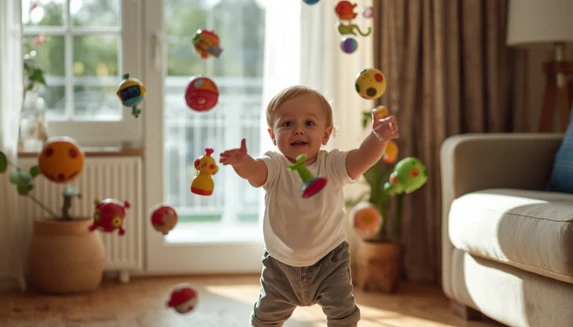
Toy throwing is common in toddlers and preschoolers. It may reflect frustration, curiosity, or sensory needs.
The first priority is always safety: remove any objects that could cause harm, and stay physically close to the child if necessary. From there, label the emotion and state the rule plainly—”you’re frustrated, toys are not for throwing”—so the child hears both empathy and the boundary in the same breath.
The next step is to redirect the behavior toward something acceptable, such as soft balls, throwing bean bags into a basket, or pounding play dough, all of which give the child a physical outlet without the risk. If the throwing continues despite redirection, apply a logical consequence by calmly removing the toy—”toys are taking a break because they’re being thrown”—and then return it later so the child can try again, which helps them understand cause and effect over time rather than experiencing the consequence as arbitrary or punitive.
Time-Out: When and How to Use It Correctly

Time-out can be part of a healthy discipline strategy when used properly. It should be viewed as a pause for emotional regulation, not a punishment.
Time-out works best for behaviors like hitting, biting, dangerous throwing, or other repeated unsafe behavior, and it should not be used for crying, emotional expression, or minor mistakes, since those are not the kinds of behavior it’s designed to address.
A general guideline for length is one minute per year of age, which works out to roughly two to five minutes maximum for most children ages 2 to 6. The method itself follows a simple sequence: 1. give one clear warning (“if you throw again, you’ll have time-out”), follow through calmly if the behavior repeats (“you threw, time-out now”) 2. keep the time-out itself boring by avoiding lectures, eye contact, or conversation, and then 3. end it positively with something like “time-out is over, let’s try again with gentle hands.”
A few common mistakes undermine the method’s effectiveness: making time-out too long, talking excessively during it, enforcing it with anger, applying it inconsistently, or treating isolation as a form of rejection rather than a pause. When done properly, time-out teaches self-control and reflection rather than fear.
Discipline Strategies That Work Best for Ages 2–6

Research-based parenting approaches consistently recommend positive, skill-building methods over punishment.
Creating predictable routines is one of the most effective foundations, since consistent schedules—regular meal times, bedtime routines, and advance warning before transitions—reduce anxiety and behavioral issues because children behave better when they know what to expect.
It also helps to use positive language, framing rules in terms of what children should do rather than what they shouldn’t: “use walking feet,” “hands stay to yourself,” or “use inside voices” all support cooperation better than a flat “no” or “stop.” Consequences should be immediate and fair, and should match the behavior in a way that makes sense to a young child—rough play means play stops, refusal means a loss of privilege, and making a mess means clean-up time—since delayed punishments tend to lose their meaning by the time they arrive.
Equally important is praising positive behavior frequently and specifically, with phrases like “you waited patiently,” “great job sharing,” or “you cleaned up without being asked,” since specific praise strengthens the exact habits parents want to see and is itself a powerful discipline strategy.
Parents can also actively teach emotional and social skills by helping children name what they’re feeling—angry, sad, excited, frustrated—and by practicing problem-solving together, asking questions like “what can you do when you’re upset?” None of this works, though, without maintaining a strong parent–child connection, since children cooperate best when they feel safe and loved, and daily connection through play, conversation, and affection measurably reduces behavior problems.
Finally, parents should model the behavior they want to see, because children imitate adults closely, so demonstrating calm communication, respectful conflict resolution, and emotional control teaches far more than words alone.
Long-Term Benefits of Using a Healthy Discipline Strategy

Consistent, respectful discipline helps children develop self-regulation, emotional intelligence, problem-solving skills, responsibility, confidence, and empathy—the core capacities that support them well beyond early childhood. Children who grow up with supportive discipline strategies are more likely to succeed socially and academically.
Harsh punishment, yelling, or humiliation may stop behavior temporarily but does not teach lasting skills.
In contrast, positive discipline builds internal motivation.
A Practical Daily Discipline Strategy Checklist
In everyday parenting, the strategy comes down to a consistent sequence: stay calm first, validate the child’s feelings, set clear limits, offer alternatives, apply logical consequences, praise positive choices, teach after things have calmed down, and maintain connection throughout. Consistency is more important than perfection, and small daily efforts create lasting change.

Frequently Asked Questions
At what age do tantrums usually peak, and when do they start improving?
Tantrums are most common between ages 2 and 4, when a child’s emotions are developing faster than their language and self-regulation skills. As verbal ability and impulse control mature through the preschool years, tantrums generally become less frequent and less intense, though occasional outbursts can still happen up to age 6, especially during fatigue, hunger, or big transitions.
Should I ignore a tantrum completely, or is that too harsh?
Ignoring the tantrum entirely isn’t the goal—what actually helps is minimizing excessive attention to the behavior itself while still staying present and keeping the child safe. That means skipping the long lectures, bargaining, and visible frustration, without abandoning the child emotionally or physically during the outburst.
Is time-out harmful to children, as some parenting approaches claim?
Time-out is not harmful when it’s used correctly—as a brief, calm pause for emotional regulation rather than as punishment, isolation, or a display of anger. Problems tend to arise when time-out is used for the wrong behaviors, made too long, delivered with anger, or applied inconsistently, so the method itself matters as much as the decision to use it.
How long should a time-out actually last?
A widely used guideline is about one minute per year of the child’s age, which generally works out to two to five minutes for children between ages 2 and 6. Longer time-outs aren’t more effective and can make it harder for a young child to reconnect with the lesson afterward.
What should I do if my child throws toys frequently?
Start by making sure the immediate environment is safe, then label the emotion and restate the rule calmly, redirect the energy toward an acceptable outlet like soft balls or bean bags, and if the throwing continues, apply a logical consequence such as calmly setting the toy aside for a short break before returning it later.
Does giving in during a tantrum make things worse long-term?
Yes—if a tantrum consistently results in extra attention, screen time, or a parent giving in to a demand, children learn that the tantrum works, which tends to reinforce and prolong the behavior over time. Responding with calm, consistent limits instead helps break that pattern.
What’s the difference between validating a child’s feelings and giving in to bad behavior?
Validating feelings simply means acknowledging what the child is experiencing—saying something like “you’re upset because the game ended”—without necessarily agreeing to the demand behind it. A parent can fully validate the emotion while still holding firm on the limit, such as not allowing hitting or throwing.
How is positive discipline different from punishment?
Positive discipline focuses on teaching skills—emotional regulation, problem-solving, and empathy—through calm limits, logical consequences, and consistent routines, rather than relying on fear, shame, or harsh punishment to stop a behavior in the moment. Research generally associates positive discipline with better long-term outcomes in self-regulation and social-emotional development, while harsh punishment tends to suppress behavior only temporarily.
✨ Final Thought
Between ages 2 and 6, children are learning how to live in the world. They are not being “difficult”—they are practicing life skills. By combining empathy with clear boundaries, parents can raise emotionally healthy, confident, and cooperative children. With patience, consistency, and evidence-based discipline strategies, families create homes where children feel safe to grow, learn, and thrive.
Because something important is happening quietly in the background, in those everyday moments:
Tiny Steps – Big Skills.
Continue Supporting Your Child’s Development:
See all posts from “Child’s World” here