
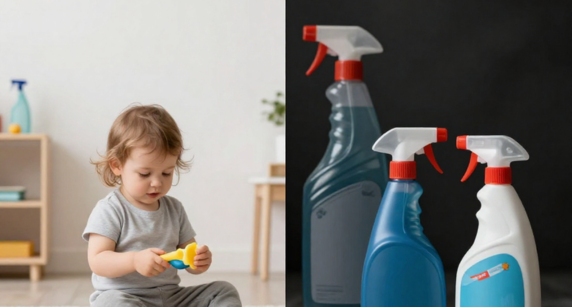
Hidden Toxins Poster
Toxin Free Home Poster
Creating a safe home for a child involves more than just padding sharp corners or installing baby gates.
Because toddlers breathe faster, have thinner skin, and spend 80% of their time playing near floor level, they are uniquely vulnerable to environmental pollutants that adults often overlook.
To truly eliminate invisible toxins from your toddler’s environment, we must look at the microscopic level—addressing the particles in our household dust, the quality of the air we breathe, and the safety of the containers we use for daily mealtime. Understanding the science behind these hidden hazards is the first step in building a sanctuary that supports your child’s developing immune and neurological systems.
Here is the breakdown of the latest pediatric environmental research.
1. The Persistence of Third-Hand Smoke (THS)
Even if you never smoke inside, toxic residue travels. THS is the chemical film that clings to a smoker’s hair, skin, and clothing, eventually settling into household dust and upholstery.
- The Study: A 2025 report in Cincinnati Children Organization analyzed nicotine levels on the hands of children in non-smoking households.
- Findings: Nicotine was detected on 94.5% of children tested, proving that “smoke-free” homes can still be chemically contaminated by outside contact.
- Impact: Exposure is linked to increased respiratory infections, asthma triggers, and sudden infant death syndrome (SIDS) risks.
- Action Tip: If a family member smokes, they should change clothes and wash their hands and hair before holding a toddler.
2. “Forever Chemicals” (PFAS) in Household Dust
PFAS are used to make carpets and furniture stain-resistant. Over time, these chemicals break off and bind to common house. Young children have particularly higher exposure to dust through ingestion due to their frequent hand to mouth activity, physical closeness to floors and carpets, and mouthing of toys or other objects that may contain dust.
- The Study: 2026 data from the Environmental Working Group (EWG) and the University of Rochester.
- Findings: Every dust sample tested contained a “cocktail” of up to 43 different PFAS variants.
- Impact: These chemicals disrupt the endocrine system and have been linked to weakened vaccine responses and immune dysregulation in early childhood.
- Action Tip: Use a vacuum with a HEPA filter to trap microscopic particles, and opt for “PFAS-free” or “untreated” textiles when buying new rugs or sofas.
3. Microplastics in Mealtime Prep
Plastics are not as stable as they appear, especially when subjected to heat during cleaning or food preparation.
- The Study: A comprehensive 2025 review by University of Calgary and published via the National Institutes of Health (NIH).
- Findings: Sterilizing plastic baby bottles with high-heat water releases up to 16 million microplastic particles per liter.
- Impact: Emerging research suggests these particles can enter the bloodstream, potentially causing low-grade inflammation and interfering with hormone signaling.
- Action Tip: Prepare formula or warm milk in glass or stainless steel containers. If using plastic bottles, let the liquid cool to room temperature before pouring it in.
4. Phthalates (Plasticizers) in Vinyl Flooring
Phthalates are chemicals used to make plastics flexible, and they “off-gas” into the air and settle into dust.
- The Study: Project TENDR (Targeting Environmental Neuro-Development Risks) (Updated 2025) published on American Journal of Public Health.
- The Finding: Phthalates are widely present in vinyl flooring and wall coverings. Because toddlers crawl and breathe closer to the floor, their inhalation rate is roughly 10 times higher than an adult’s.
- The Impact: Robust longitudinal studies now link phthalate exposure to impaired brain development, specifically increasing the risk for ADHD, learning disorders, and behavioral problems.
- Action Tip: Use a “wet-mop” or “damp-dust” method rather than sweeping, which just kicks these particles back into the air.
5. VOCs from “Clean” Household Sprays
Even “conventional” cleaning can lead to long-term respiratory issues if the products aren’t chosen carefully.
- The Study: Effects of Household Cleaning Products on the Lungs: An Update (March 2025) by Environmental Working Group Scientists.
- The Finding: Persistent weekly use of multiple disinfectants and cleaning sprays by parents was associated with a 1.7x higher risk of current asthma and wheezing in their children.
- The Impact: Quaternary ammonium compounds (QACs) and volatile organic compounds (VOCs) are often inhaled as aerosols during cleaning, irritating the child’s sensitive airway.
- Action Tip: Switch to “green” cleaning products (which generate the fewest VOCs) and avoid spray nozzles when possible—apply the cleaner to a cloth first to prevent it from becoming airborne.
6. The “Natural” Fragrance & Essential Oil Trap
Many parents use essential oils or “natural” lavender-scented lotions to help toddlers sleep, unaware that these concentrated plant compounds can act as potent endocrine disruptors or allergens.
- The Study: A 2024 longitudinal study published in the Journal of Clinical Endocrinology & Metabolism.
- Findings: Researchers found that repeated topical exposure to lavender and tea tree oils was associated with “prepubertal gynecomastia” (abnormal breast tissue growth) in boys and early hormonal shifts in girls.
- Impact: Even “natural” fragrances contain terpenes that, when exposed to indoor air, create secondary pollutants like formaldehyde, irritating a toddler’s sensitive respiratory tract and skin.
- Action Tip: To truly eliminate invisible toxins, stick to “fragrance-free” (not just “unscented”) moisturizers and avoid using essential oil diffusers in small, poorly ventilated nurseries.
7. The Hidden Risks in “Safe” OTC Syrups and Gels
Many parents reach for “natural” teething gels or elderberry syrups, assuming they are entirely benign. However, some contain hidden active ingredients or contaminants that can be life-threatening to toddlers.
- The Study: FDA Pediatric Safety Communication & Health Alert Network (HAN).
- Findings: The FDA has issued multiple “Stop Use” orders for teething gels containing Benzocaine and certain homeopathic tablets found to have inconsistent amounts of belladonna or lead contamination.
- Impact: Benzocaine can lead to methemoglobinemia, a rare but fatal condition that reduces oxygen in the blood. Additionally, heavy metal contamination in “natural” root extracts can impact long-term cognitive development.
- Action Tip: To eliminate invisible toxins, swap numbing gels for chilled (not frozen) teething rings. Always check the “Inactive Ingredients” for dyes or propylene glycol, and choose supplements third-party tested for purity.
Conclusion: Progress Over Perfection
Protecting your toddler from invisible household toxins can feel like a daunting task, but the goal isn’t to create a sterile, laboratory-grade environment. Instead, it is about making informed, incremental swaps that reduce your child’s overall “toxic load.”
By implementing simple habits—such as a “shoes-off” policy at the front door, switching to glass for meal prep, and using a HEPA-filter vacuum—you are actively supporting your child’s developing immune system and brain architecture. Science shows that a toddler’s body is incredibly resilient when we provide a “buffered” environment that minimizes unnecessary chemical stress.
Start with one change this week. Whether it’s switching to a damp mop or replacing one plastic bottle with stainless steel, these “tiny steps” lead to the “big skills” of lifelong health and wellness.