
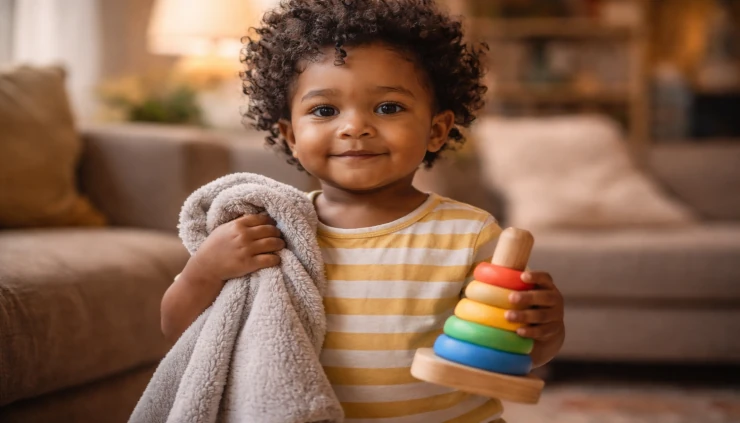
From the very first smile to their first bike ride, the journey from birth to age six is one of the most important periods of human development.
Every giggle, tumble, and question is a sign that your child’s brain is building connections at a remarkable pace — faster than at any other time in life.
Research from the Harvard Center on the Developing Child shows that in the first years of life, more than one million new neural connections form every second. The quality of a child’s early experiences — including the toys they play with and the interactions they have — directly shapes the brain’s architecture for learning, behavior, and health.
The good news? You don’t need expensive programs or structured lessons. The most powerful learning happens through simple, everyday play — with the right tools and a present, engaged parent by their side.
The Role of Parents in Skill Development
No matter the age, the most powerful “toy” in your child’s world is you. Responding to their interests, playing alongside them, and encouraging exploration are what truly drive learning. When children feel safe, supported, and engaged, they are more likely to take the small daily steps that lead to big achievements.
No toy, however well-designed, replaces the irreplaceable role of a present, responsive parent.
Research consistently shows that the single greatest predictor of healthy child development is the quality of early relationships — not the price tag of the toys. What matters most is not perfection, but presence. Getting on the floor and playing alongside your child, narrating everyday moments, celebrating effort over outcome, and creating a home environment where curiosity is welcomed — these are the things that truly shape a growing mind.
Toys are tools. You are the teacher. And the classroom is every ordinary moment of your day together.
(If you want a quick milestone overview, try our Milestones 0–60 Months quiz Or, check the Developmental milestones for infants from extension.psu.edu for more details.)
How to Choose the Right Toy at Every Stage
With thousands of options available, choosing a toy can feel overwhelming. Here are four simple principles that child development experts agree on:
1. Match the toy to the stage, not just the age. Every child develops at their own pace. A toy slightly above your child’s current ability encourages growth; one far above creates frustration. Watch what your child is naturally drawn to and let that guide you.
2. Open-ended is almost always better Toys with one “right” use have a short lifespan of interest. Open-ended toys — blocks, art supplies, sand, water, pretend play props — grow with your child and support creativity, problem-solving, and longer play sessions.
3. Simple beats flashy Research from the University of Toledo found that highly electronic toys actually produced fewer adult words, fewer child vocalizations, and fewer conversational turns compared to traditional toys or books. Simpler toys invite more interaction — between parent and child, and between the child and their own imagination.
4. Play together whenever you can The same toy produces dramatically different developmental outcomes depending on whether a child plays alone or with an engaged adult. Even 10–15 minutes of true, undistracted floor play daily makes a measurable difference.
Below, you’ll find what to expect at each stage from 0 to 6 years, what skills are developing, and which toys and activities best support that growth — naturally and joyfully.
0–12 Months: Foundations Through Senses and Movement
What’s happening in your baby’s brain
In the first year, babies are building the very foundations of all future learning. Their brain is wiring itself for sight, sound, touch, movement, and emotional connection. Every sensory experience — a rattle shaking, a face smiling, a texture felt for the first time — is laying down neural pathways that will support language, memory, and thinking for years to come.
Key skills developing at this stage: visual tracking, grasping, object permanence (understanding things still exist when hidden), early communication through babbles and gestures, and the first steps of emotional bonding and trust.
What you can do
The most important thing at this stage is responsive interaction — talking to your baby, making eye contact, and responding to their cues. Studies show that “serve and return” interactions (when a baby reaches out and a caregiver responds) are one of the most powerful ways to build brain architecture.
Simple activities like peek-a-boo, singing, narrating your day, and gentle tummy time all support healthy development in profound ways
Toys and Activities to Support Growth
- High-contrast toys for newborn vision development
- Soft rattles to → encourage grasping reflex and cause-and-effect understanding
- Tummy time mats to build neck and upper body strength
- Simple board books to introduce the rhythm of language
Popular parent-loved picks include the Manhattan Toy Winkel Rattle, Black & White High-Contrast Flashcards, and the Bright Starts Tummy Time Playmat — all consistently praised for gentle, meaningful sensory development.
At this stage, it’s not about complex learning — it’s about connection. Smiling, making eye contact, and responding to your baby’s babbles help them feel secure and start understanding communication.
1–3 Years: Building Mobility, Language, and Curiosity
What’s happening in your baby’s brain
Once walking begins, a whole new world opens up. Toddlers are natural explorers. They want to climb, touch, and test everything. This is when gross motor skills (running, jumping, climbing) and fine motor skills (stacking blocks, turning pages) start to shine.
What you can do
Language develops rapidly during these years. Reading simple picture books, naming everyday objects, and asking “What’s that?” encourage vocabulary growth. Songs and rhymes become powerful tools for early speech.
Attention and focus also evolve rapidly in this stage — see Improve Kids Attention Through Play for strategies.
Toys and Activities to Support Growth
- Push-and-pull toys to strengthen balance and coordination
- Shape sorters and stacking cups to build problem-solving skills
- Musical instruments like shakers or drums for rhythm and sound recognition
- Pretend play sets (kitchen, doctor kits) to develop imagination and social skills
Popular parent-loved picks include the Manhattan Toy Winkel Rattle, Black & White High-Contrast Flashcards, and the Bright Starts Tummy Time Playmat — all consistently praised for gentle, meaningful sensory development.
At this stage, it’s not about complex learning — it’s about connection. Smiling, making eye contact, and responding to your baby’s babbles help them feel secure and start understanding communication.
3–6 Years: Refining Skills and Preparing for School
What’s happening in your toddler’s brain
The preschool years are a period of remarkable cognitive leaps. Children at this stage can follow multi-step instructions, understand that others have different thoughts and feelings (called “theory of mind”), begin recognizing letters and numbers, and engage in rich imaginative play with storylines and characters.
Key skills developing at this stage: fine motor control (drawing shapes, using scissors, beginning to write), early literacy and numeracy, logical reasoning, creative thinking, emotional regulation, and social skills like sharing, turn-taking, and cooperation.
Executive function skills — the ability to plan, focus, and control impulses — develop rapidly between ages 3 and 6 and are among the strongest predictors of academic and life success
What you can do
This is a wonderful age for games with simple rules, creative projects, and collaborative play. Board games — even simple ones — teach children to wait, cope with losing, follow instructions, and strategize.
Art projects build fine motor control and self-expression. Building challenges stretch spatial reasoning and early engineering thinking.
Outdoor play remains essential. Studies show that unstructured outdoor time supports attention, reduces stress, and improves sleep quality in young children.
Peer play becomes more important now. Group games teach teamwork, sharing, and empathy. Counting games, memory cards, and simple board games help children practice early math and logic skills in a fun way.
Toys and Activities to Support Growth
- Building sets (LEGO®-style blocks) for creativity and problem-solving
- Art supplies for drawing, painting, and crafting
- Early board games to practice taking turns and following rules
- STEM kits for simple science and engineering projects
Popular Toys for this age: Fresh Mart Grocery Store for older kids, Set Toys with Drill, Life Cycle Animal Kit
As they approach age six, children begin showing longer attention spans, stronger critical thinking skills, and the ability to work toward goals. This is a wonderful time to introduce toys and activities that challenge them just enough to keep learning exciting.
✨ Final Thought
Every stage of your child’s early years is an opportunity to nurture their mind, body, and heart. The right toys and activities aren’t about rushing development — they’re about meeting your child where they are and helping them take the next step. From rattles in infancy to building blocks in preschool, each moment of play is a building block toward independence, creativity, and confidence.
As your little one grows, remember that the biggest skills often come from the tiniest steps — steps you can support every day with love, attention, and the right tools for learning and fun.
Because something important is happening quietly in the background, in those everyday moments:
Tiny Steps – Big Skills.
Continue Supporting Your Child’s Development:
- How toddlers explore early milestones → Moving Bodies – Clever Minds
- How attention shapes learning at every age → Eyes On Mind On
- Check your child’s progress → Milestones 0–60 Months (Quiz)
See all posts from “Child’s World” here